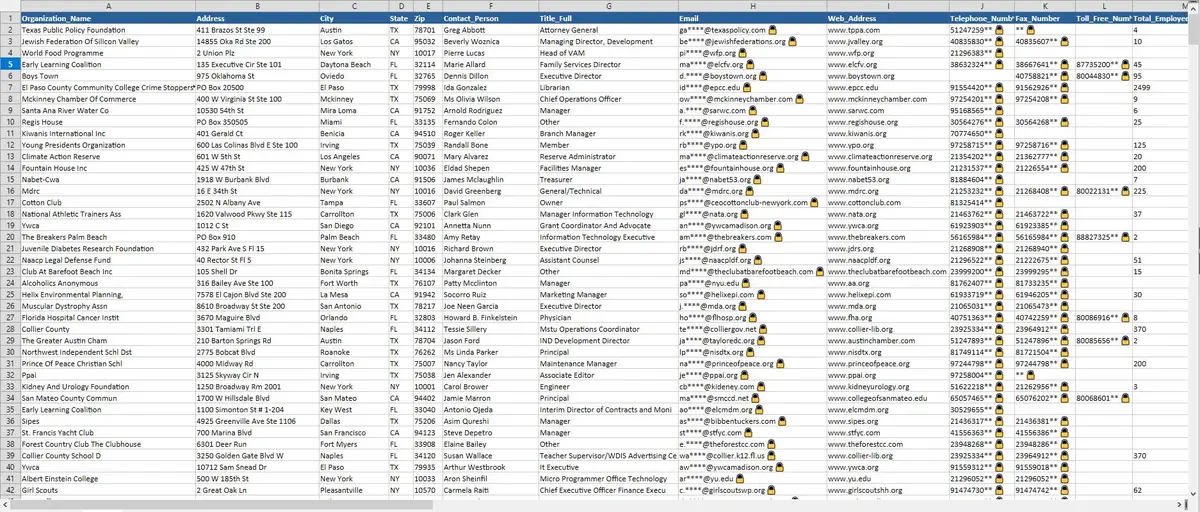
Nonprofit organizations in Illinois — the underlying dataset.
The Illinois portion of the NonProfitLists.com dataset contains 67,287 nonprofit organization records — every IL-registered 501(c) we have been able to cross-verify against IRS filings and state charity registrations. The set spans charities, private foundations, educational institutions, religious bodies, healthcare nonprofits, arts and cultural organizations, social service agencies, environmental groups, and advocacy organizations across Chicago, Aurora, Rockford, and Naperville and every smaller community between them.
Because the data is delivered as one national CSV covering all 50 states, Illinois is not sold as a separate file. The $379 purchase includes every state. If your work is Illinois-specific, filtering to IL records in Excel or Google Sheets takes about ten seconds — and you retain the full national file for whenever a project expands beyond state lines.
What the Illinois rows contain
Each of the 67,287 Illinois rows carries the same 21 columns as every other row in the dataset: organization's full legal name, street address, city, IL state code, ZIP, named contact person with their job title, direct email (where on file), phone number, fax, toll-free number, website URL, total and site-level revenue, total and on-site employee counts, NAICS code, year founded, title classification code, and latitude/longitude coordinates. The file is UTF-8 CSV and opens in Excel, Google Sheets, LibreOffice, Apple Numbers, or any CRM that accepts CSV import.
Source and methodology
Illinois records are built on the same foundation as the national dataset: IRS Exempt Organization Business Master File entries; Illinois charity registration records filed with the state Attorney General's office (where applicable); Illinois Secretary of State business registry filings; and publicly listed organizational profiles. Every record traces to an official public source. We do not scrape social media, we do not generate synthetic contacts, and we do not include third-party data that isn't licensed for resale.
Typical buyers of the Illinois data
Grant writers and fundraising consultants based in Illinois or serving Illinois-registered clients use the file to build targeted prospect lists of foundations and operating nonprofits. Software vendors — donor CRMs, fundraising platforms, grant management tools, nonprofit accounting software — use it to reach Executive Directors and Development Officers at organizations that fit their ICP. Researchers at Illinois universities use the NAICS, revenue, and founding-year fields for sector analysis. Journalists covering the Illinois nonprofit landscape use it to source named contacts at specific organizations. And specialized providers — D&O insurance brokers, nonprofit attorneys, fiduciaries — use it to identify decision-makers in their territory.
A note on coverage
Coverage rates for contact fields are disclosed exactly as found. Across the dataset, approximately 72 percent of records carry a phone number, 54 percent carry a website, 40 percent carry a fax, and 30 percent carry a direct email address. Illinois's coverage distribution tracks closely with the national figures. Public records don't include full contact details for every organization, and we don't pretend they do. For bulk outreach, we recommend running the file through an email validation service like NeverBounce or ZeroBounce before sending — standard practice for any bulk B2B data.