The largest U.S. nonprofit organizations dataset, made downloadable.
NonProfitLists.com publishes a structured dataset of every recognized nonprofit organization registered in the United States. The file contains 1,653,289 records spanning charities, private foundations, social service agencies, educational institutions, healthcare organizations, religious bodies, arts councils, environmental groups, and advocacy organizations across all 50 states. Rather than a subscription platform with limited monthly searches, the data is sold as a single CSV file for one payment of $379, with full ownership and no recurring fees.
The dataset is built for buyers who already know what they want to do with bulk nonprofit data and would rather not pay enterprise rates for the privilege. Researchers studying philanthropy and the social sector. Grant writers building prospect lists. Software vendors reaching nonprofit decision-makers. Insurance brokers identifying organizations in their territory. Direct mail companies running B2B campaigns. Journalists and policy analysts producing sector analyses. The common thread: the work depends on having complete, structured, citable data — and the underlying public records are scattered across dozens of federal and state databases that take significant work to consolidate.
What's actually in the file
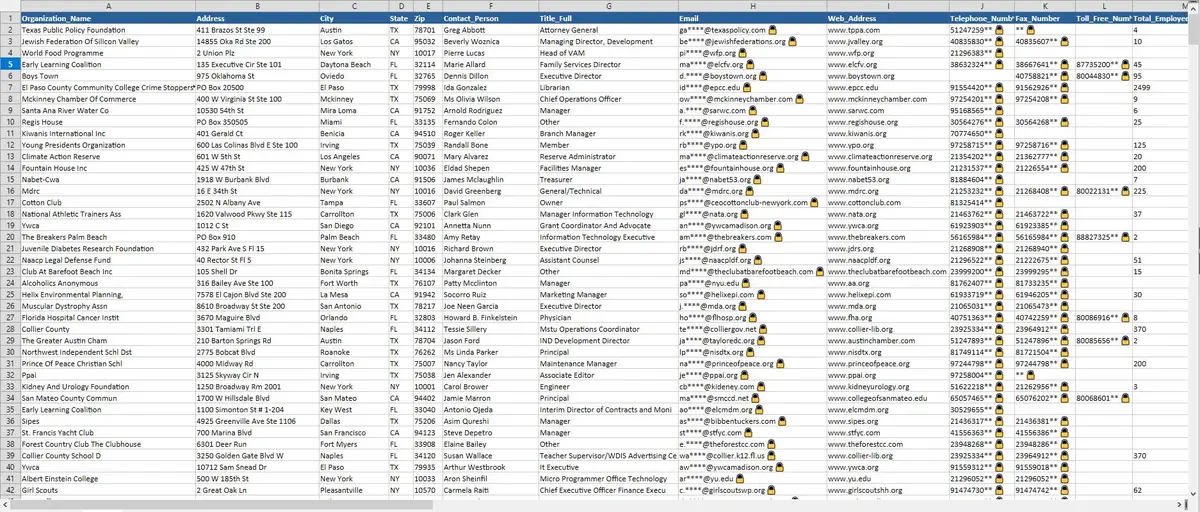
Each of the 1.65 million rows represents one nonprofit organization. Each row carries 21 columns: the organization's full legal name, physical street address, city, state, ZIP, and county; a named contact person with their job title; direct email address (where on file); phone, fax, and toll-free numbers; website URL; total annual revenue and site-level revenue; total employee count and on-site headcount; NAICS industry classification code; year founded; standardized title code; and latitude/longitude geo-coordinates. The file is UTF-8 encoded CSV, opens cleanly in Excel, Sheets, LibreOffice, Apple Numbers, or any CRM that accepts CSV import — no reformatting, no column remapping, no junk rows.
How the data was assembled
The foundation of the dataset is the IRS Exempt Organization Business Master File, which lists every recognized 501(c) organization in the country with legal name, EIN, address, and NTEE classification. State-level charity registration databases — maintained by Attorneys General offices in states that require nonprofits soliciting donations to register — layer in officer names, contact details, and revenue disclosures. Secretary of State business registries provide registered agent contacts and incorporation dates that help cross-validate ambiguous matches. Publicly listed organizational profiles — staff pages, contact pages, program directories published by the organizations themselves — round out the contact information.
Throughout, every record traces back to a legitimate public source. We do not scrape social media. We do not purchase third-party data licensed under terms that prohibit resale. We do not generate synthetic profiles or use AI to fabricate contact information. Revenue figures, employee counts, and founding years come from official filings and public disclosures — data you can cite in academic work or rely on in commercial outreach.
State-by-state coverage
All 50 states are included in the single $379 purchase. The five largest state files are Florida (185,328 records), California (162,639), Texas (130,198), New York (98,290), and Ohio (65,995). Mid-size states are equally well-represented: Virginia (52,682), Michigan (48,508), Massachusetts (48,214), Washington (46,080), Georgia (41,882). Even smaller states maintain meaningful coverage — Wyoming (3,518), Hawaii (3,325), Delaware (4,674). The file is filterable by the State column in any spreadsheet program, so building a state- or region-specific list takes seconds.
Dataset facts
- 1,653,289 records
- 21 fields per row
- 1.19M phone numbers
- 888K website URLs
- 660K fax numbers
- 493K direct emails
- All 50 states
- UTF-8 CSV format
- $379 one-time
- Instant download
- Lifetime access
- PayPal checkout
What we do not claim
A note worth making explicit: the file is compiled, not verified. We do not run live email or phone validation, and we don't pretend that every email in the file is currently active. For large outreach campaigns, run the file through a verification service such as NeverBounce or ZeroBounce before sending — that's standard practice for any bulk data, regardless of source. Coverage rates for each contact field are disclosed exactly as found. Anyone selling complete contact coverage at this scale is overstating what public records contain.